In the conclusion of my first post, I mentioned the relationship between bodily cycles and bodily purpose. This gets at what we call “the Hearth principle,” the center of CV’s perspective on energy, both its purpose and its healthy state.
By energy, I mean the ability of organism to take nourishment and reserve and cleanly transform them into warmth, circulation, attention, movement, and purposeful action. It’s easy to confuse energy with output. Some wellness circles can give you the impression that energy is the ability to constantly increase motivation, stimulation, intensity, productivity, or athletic capacity. CV’s emphasis is different. Here, we’re primarily interested in energy that’s both stable and sustainable. The distinction is important because it’s very possible to feel intensely ‘energized’ without having a body that’s truly nourished.
We’ve found that many health issues run on a spectrum from “failure to spark energy” to “failure to contain energy.” Some bodies have more trouble turning nourishment and reserve into movement and action in the first place, being more vulnerable to stagnation (or constriction). Other bodies have no trouble generating energy but do have difficulty directing and containing that energy once it’s been produced, making them more vulnerable to burnout (or pressure).
When looking for energy, people with more sluggish or constricted constitutions may try to “borrow a spark” to find that energy they’re having difficulty generating organically. That can come through things like sugar, caffeine, nicotine, intense sensory input, emotional intensity, or novelty-chasing. Alternatively, people with these kinds of constitutions may just give up on energy production altogether and fall into total inertia.
When looking to keep energy going, people with more fast-burning or pressurized bodies often try to “borrow momentum” to keep the body going past its natural limits. That can often take the form of things like prolonged social intensity, late night work, skipping meals, exercise stacked on top of clear fatigue, or caffeine use throughout the day. Once they’re no longer able to maintain this compensatory drive, they can sometimes enter phases of shutdown, exhaustion, flatness, and irritable avoidance.
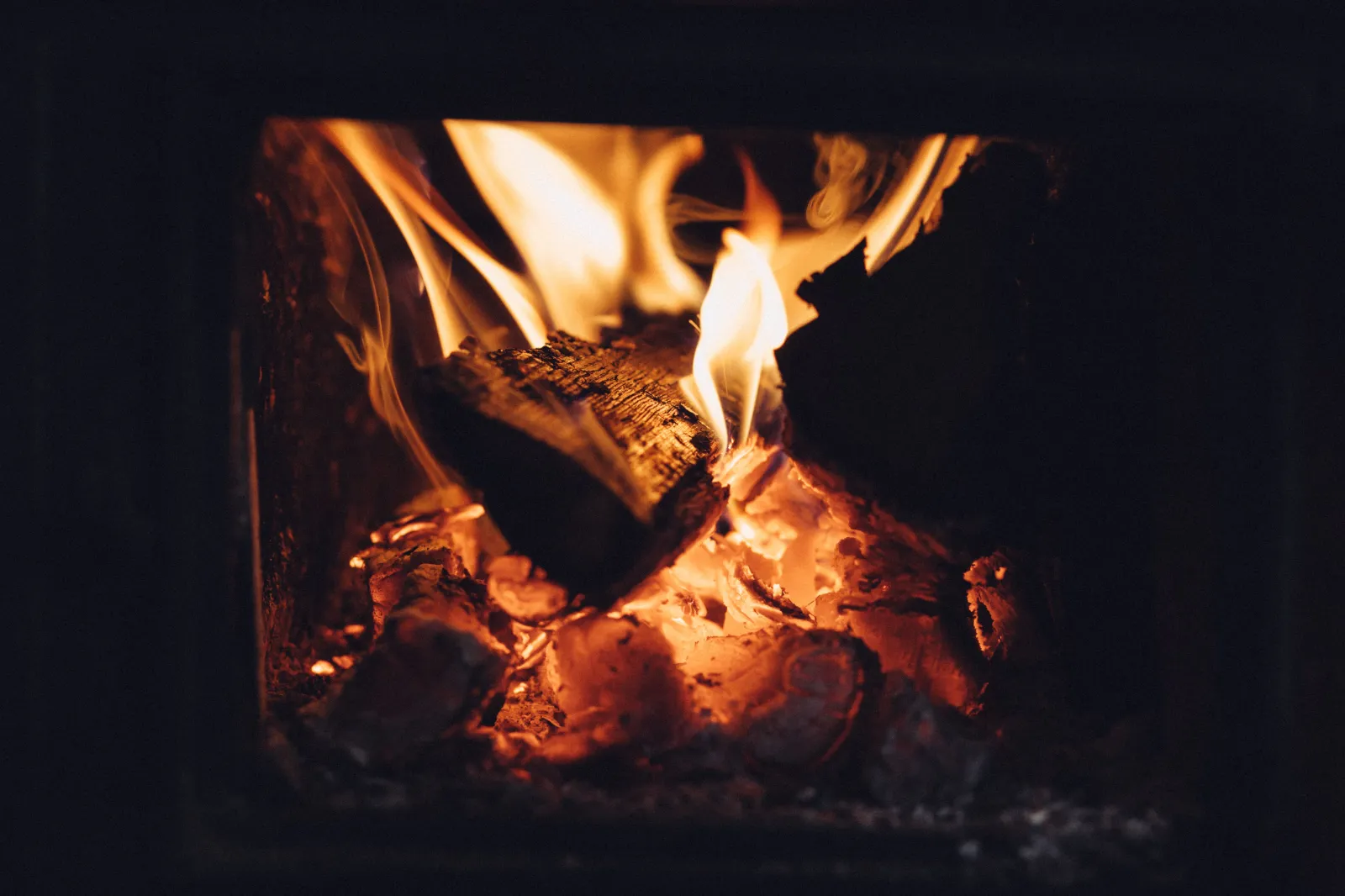
In between the extremes of “failure to spark” and “failure to contain,” there’s the ideal CV model for energy. Picture a steady fire burning in a hearth. A well-burning hearth fire needs fuel, transformation, containment, airflow, tending, and periods of quiet. Too little fire does nothing. Too much consumes its own fuel and burns out. You don’t want maximum heat or minimal burning, you want what’s needed for sustainable useable warmth. When the Hearth is burning properly in the body, we’re able to take the things that restore and build us (food, sleep, daily rhythm, reserves, etc) and cleanly digest and assimilate them, smoothly converting these resources into circulation, work, relationships, and movement. Reacting to the concept of hearth-like energy, a client recently told me “We’ve heated with a wood stove for over 25 years. In that time, I feel like I’ve developed a sixth sense in fire/stove management to get to that sweet spot where it’s not rapidly building to a certain temperature nor slowly dying out for lack of air or fuel, but just calmly maintaining a steady glowing heat.”
So then, what exactly is “the Hearth” in terms of the body’s internal systems?
To help answer that, I’ll quickly go over some basic Traditional Chinese Medicine terminology, which I know will be entirely new to some readers and very familiar to others. CV uses TCM as an important reference point because of its tremendous sophistication in analyzing bodily patterns and paying careful attention to how nourishment, expenditure, movement, rest, digestion, sleep, emotion, season, and environment are all working together in a given person. One of its main contributions is a rich practical vocabulary for discussing what it looks like when the body’s baseline processes of receiving, transforming, circulating, containing, and restoring vitality are either functioning rhythmically or out of balance.
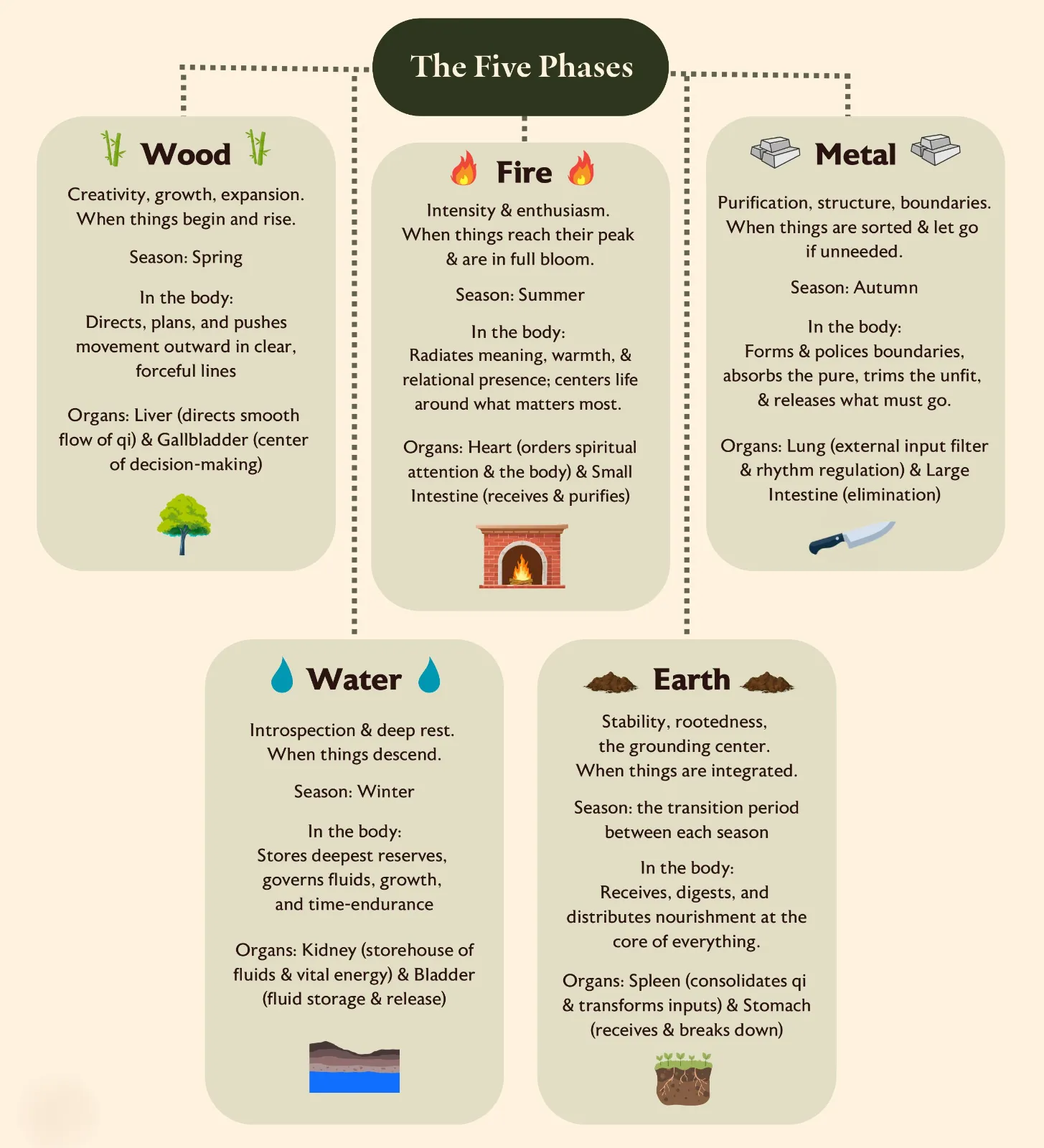
A central concept that CV receives from TCM is the Five Phases, a pattern of change that can be viewed in both nature and the body. Those phases are Wood, Fire, Earth, Metal, and Water. These terms look ‘elemental’ but they’re distinct from the classical Western Four Elements (Earth, Air, Fire, and Water). Those elements are poetic descriptions of the basic qualities of the cosmos, whereas the Five Phases are far more clinically precise concepts, describing dynamic processes in seasonal and bodily rhythm. To quickly go by these phases one by one:
Wood: Associated with springtime and the Liver/Gallbladder. It relates to direction, planning, and movement being pushed outward in clear, forceful lines (kind of like a tree!).
Fire: Associated with summer and with the Heart/Small Intestine. It relates to the radiation of meaning, relational presence, the sorting of what truly belongs at the core of a person, and warmth (kind of like a flame!).
Earth: Some classical TCM models associate it specifically with later summer, others see it as the transition period between every season. CV prefers the latter. Also associated with the Spleen/Stomach. It relates to reception, digestion, and the central process of distributing nourishment (kind of like soil!).
Metal: Associated with autumn and the Lungs/Large Intestine. Associated with the formation and policing of boundaries, taking in what’s pure, cutting away what’s unfit, and releasing what must go (kind of like a blade!).
Water: Associated with winter and Kidney/Bladder. Associated with the deepest reserves of life and the governance of fluids, growth, and time-endurance (kind of like an aquifer!).
All that to say, the core CV concept of Hearth energy is about the unique relationship of Earth/Spleen to Heart/Fire. Even if the language seems exotic, the implications are extremely practical. “Spleen” and “Heart” here do include the anatomical organs but we’re talking about more than a filter and a pump. The Spleen here refers to a functional system related to digestion, transformation, nourishment, and the ability to make what is taken in useful to the whole organism. The Heart here refers to a functional system with a governing role related to circulation, the presence of mind in the body, and the coherent ordering and expression of life.
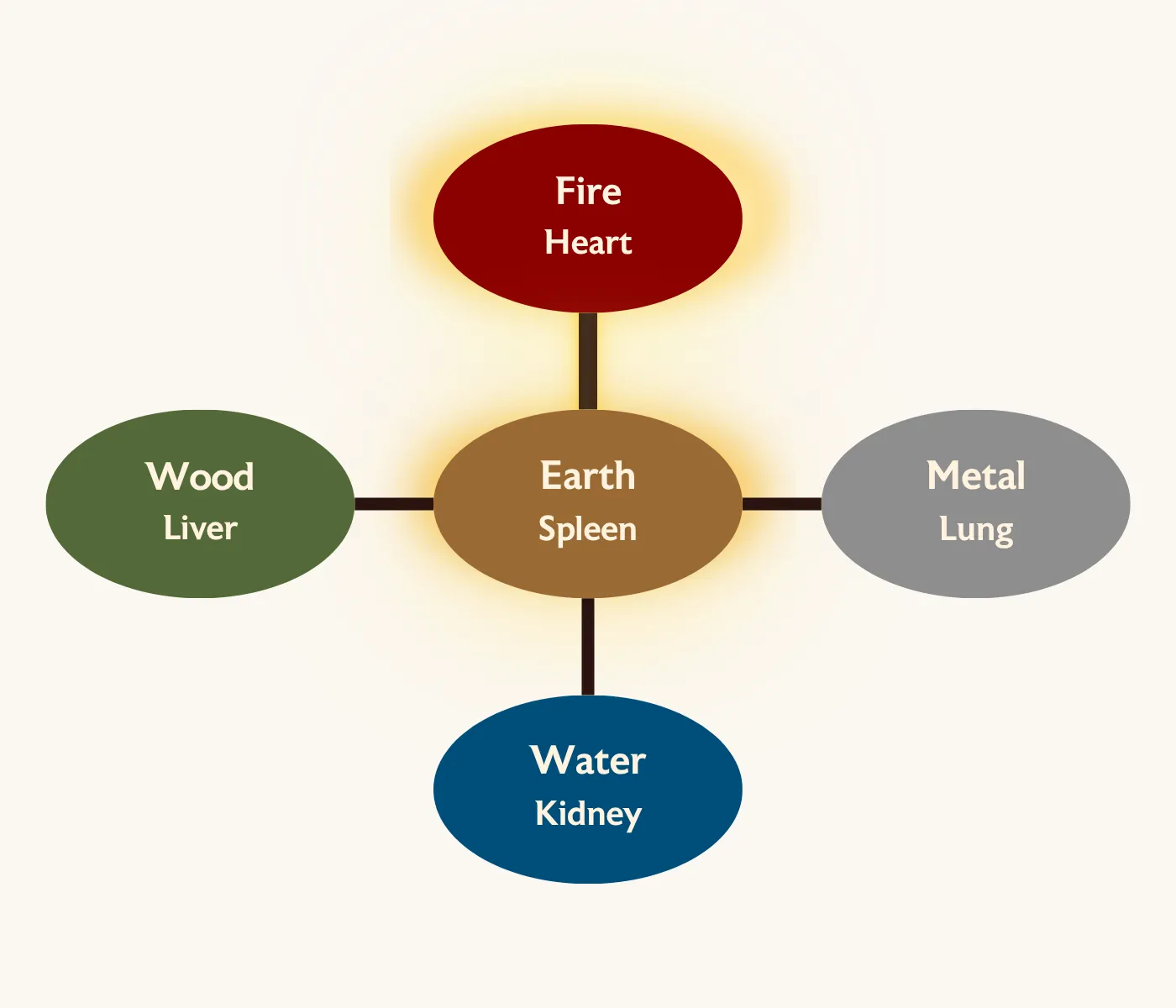
Together, these two systems form the central Hearth: Fire (clean burning energy) housed in Earth (a nourished stable center). To make it explicit, “the Hearth” is our shorthand for the Spleen-to-Heart axis (hence, Hearthroot Wellness!). The Spleen receives inputs and transforms them into something the body can actually use. The Heart then takes that received and processed vitality and gives it warmth, circulation, coherence, and outward expression. If Earth/Spleen is weak, then there’s not a foundation of stable fuel to ground and sustain energy. If the Heart/Fire is dysregulated, then energy can become scattered and difficult to contain. Ideal bodily energy depends on both these systems working together so that the body can both spark vitality and contain vitality without difficulty.
The other reason this axis is important to CV is that it’s essentially the input-transformation-output axis. So, even if a disease or imbalance lies primarily elsewhere in the body, our body organism always relies on a steady Hearth to properly take in and use inputs in order to respond to and recover from the problem.
To help our clients calibrate their Hearth, we look closely at factors such as meal timing and digestibility (not just “healthy food” in the abstract), sleep patterns, daily rhythm, movement/exercise patterns, stimulation load and stress, and what kind of recovery you’re getting after physical or mental exertion.
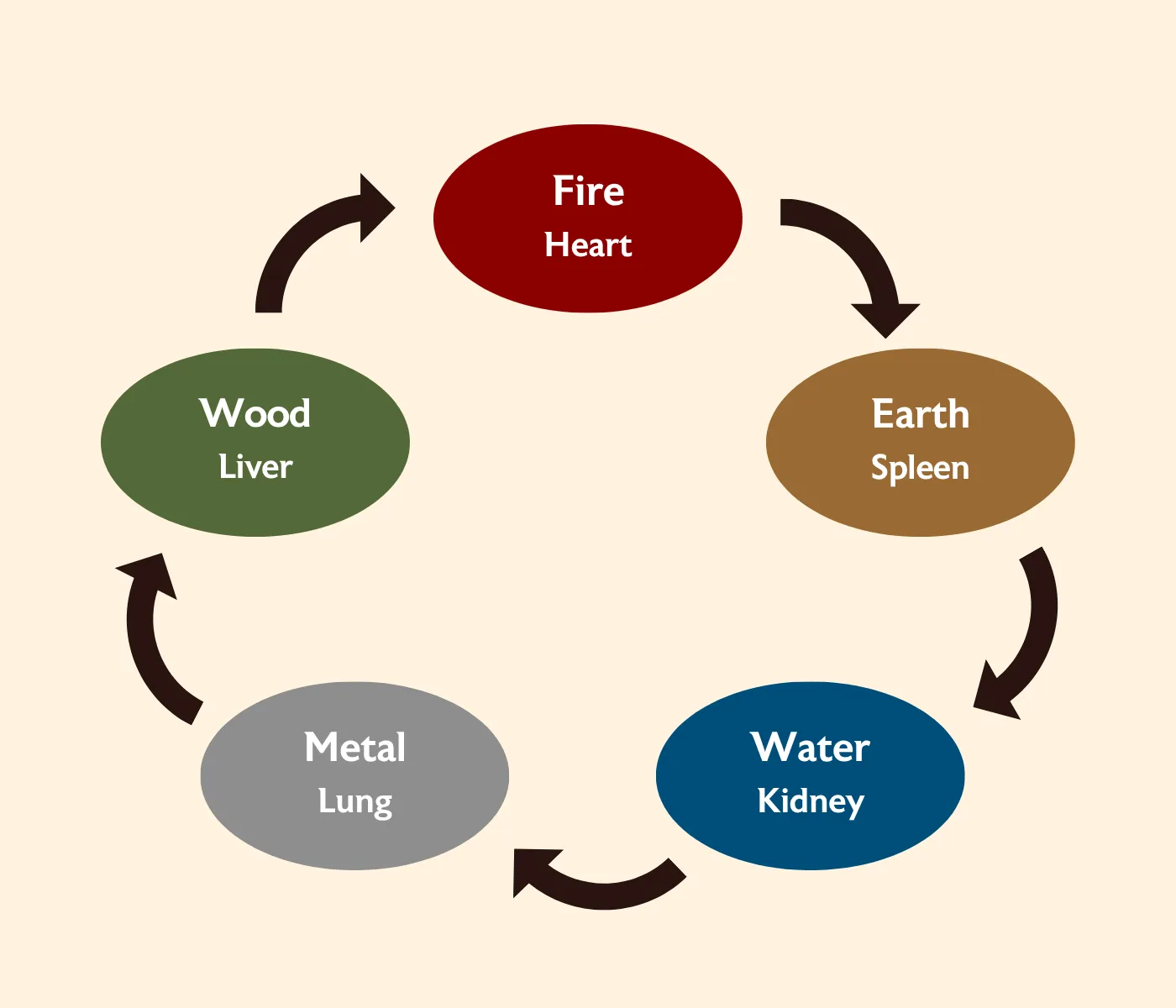
A difference between classical TCM and CV is that TCM emphasizes more the ongoing cyclical relationship between the Five Phases. Whereas, although CV is very focused on rhythmic cycles (see my last post), we emphasize the Spleen to Heart relationship as the center of bodily functioning, oriented toward a purposeful well-ordered life. And while CV pays strong attention to proper recovery and sees modern patterns of activity as often absurdly overstimulated, it isn’t a spa therapy system of “self-care.” We let ourselves rest and descend precisely so that we are capable of sustained well-ordered activity, as related to things such as service to others, family life, prayer, and vocation.
Therefore, our model of the Phases looks less like this:
And more like this:
As a short a theological aside, for those interested, Orthodox readers may have already picked on a beautiful typological reflection of theosis that emerged as we cultivated this health model. From the sublime pre-communion prayer of St. Symeon the New Theologian: “And taking courage from the wealth of Thy benefactions to us, rejoicing and trembling at once, I partake of Fire, I that am grass. And, strange wonder! I am bedewed without being consumed, as the bush of old burned without being consumed.” Scripture refers to our human selves as “earthen vessels.” Fire is of course closely related to purifying divine illumination. The Spleen/Heart axis is all about holding “Fire” without being consumed, much as we Orthodox are taught to imitate the Theotokos humbly receiving Christ Himself into her earthly body.
Today as I write this, the icon of the Theotokos “the Unburnt Bush” is commemorated, filled with imagery related to earthly flesh being graced with divine fire. From an Orthodox perspective, worldviews that don’t recognize glorious union with God (becoming “partakers of the divine nature,” as scripture says) as the purpose for which we were created are failures to ‘spark energy,’ spiritually speaking. Conversely, occult/New Age/pantheistic worldviews that collapse the human, the divine, and nature into a single blob can be seen as failures to ‘contain energy,’ spiritually speaking. Orthodoxy’s view of a humble and sober liturgical life in service and worship of God, mystical but not chasing ‘peak experience,’ is fascinatingly parallel to the physiological Hearth.
 This is just a personal observation, not a dogmatic claim. But if health is indeed not about dispelling pain (as there are many saints who underwent grave illness for their salvation) or chasing external markers of strength, but rather about a graceful relationship with time and space (again, see my last post), it would be unsurprising to see such an elegant parallel between the realm of spiritual and bodily purpose, even as it’s important to never conflate these registers.
For all my readers, Orthodox and not, I hope this post has made clear why the input-transformation-output axis at the center of the body is the key to clean, sustainable, steadily burning energy. Next time you think about what gives you energy, I’d encourage you to expand that question to “What helps me to produce energy cleanly and sustain it reliably?”